


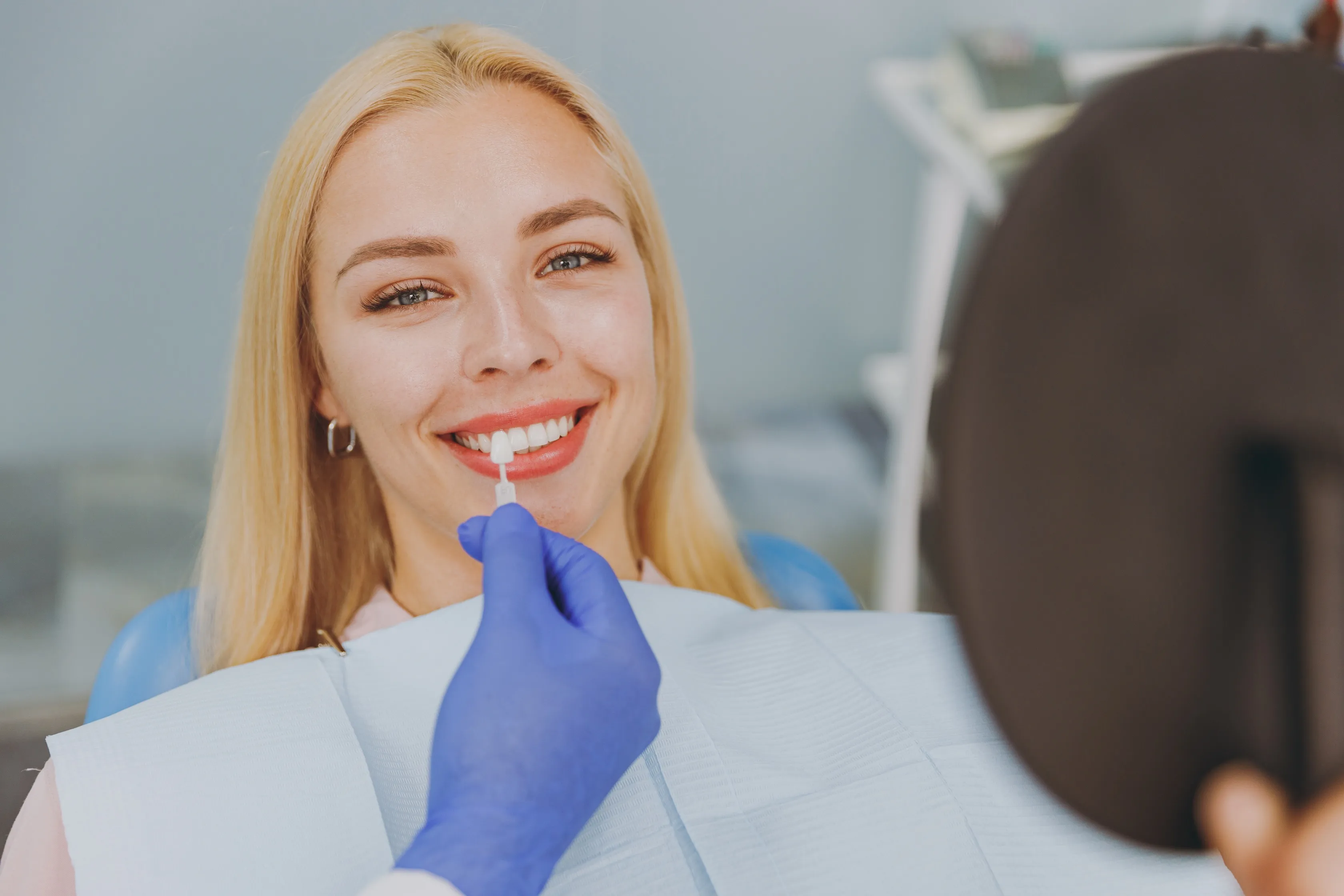
Quick answer: Dental veneers are thin, custom shells, usually porcelain, bonded to the front of your teeth to change their color, shape, or size. Once they are bonded and your bite is adjusted, most people say they feel like their own teeth within a short time. Porcelain veneers often last 10 years or more, and cost depends on how many teeth and the materials used.
You catch yourself in a photo and notice it again.
The chip on your front tooth. The gap. The stain that whitening never quite fixed. You have started smiling with your lips closed, and you are tired of it.
You have heard veneers can change all of that. But you have also heard they look fake, feel bulky, ruin your teeth, and cost a fortune.
The simple answer is that veneers are thin porcelain covers that can make your smile look brighter, more even, and more balanced, and when they are well made, they feel natural.
The more honest answer is that veneers are usually permanent, they require removing a small amount of enamel, and they are not the right fix for every smile concern.
Here is what you should know before you decide.
What Are Dental Veneers?
A veneer is a thin shell custom-made to fit over the front surface of a tooth. It is bonded in place with a strong dental adhesive.
Veneers can help with:
- Stains that do not respond to whitening
- Chipped or worn edges
- Small gaps between teeth
- Teeth that are uneven, too short, or oddly shaped
- Mild crowding, when orthodontics is not preferred

At our office, we offer custom porcelain veneers, made in a professional dental lab and matched to your shade and proportions.
Do Veneers Feel Like Real Teeth?
For most people, yes, after a short adjustment.
Right after placement, your tongue may notice the new edges, and the teeth may feel slightly smoother or fuller than before. Your bite is checked and fine-tuned at the placement visit so the teeth meet comfortably.
Patients tend to be happy with how veneers look and feel. In a study comparing different types of veneers, overall satisfaction was 76% at placement and 78% after two years, and people with porcelain veneers were more satisfied than those with direct composite veneers (Meijering et al., 1997).
Some people notice mild temperature sensitivity for a short time after treatment. If it lasts or gets worse, let us know. Our guide to hypersensitive teeth explains the common causes.
Do Veneers Ruin Your Natural Teeth?
Porcelain veneers usually require removing a thin layer of enamel so the veneer sits flush and does not look bulky. That change is permanent, which is why veneers are considered an irreversible treatment.
But how much is removed matters.
In a 12-year study of 580 porcelain veneers, more than 80% of preparations were kept within enamel when a mock-up guided the preparation. When preparations stayed within enamel, failures from debonding and leakage dropped to 0% (Gurel et al., 2012).
The goal is to remove as little tooth as possible and keep the bond in enamel.
How Long Do Porcelain Veneers Last?
The research is encouraging.
A systematic review estimated an overall survival rate of 89% over a median of 9 years. Glass-ceramic veneers showed about 94% survival and feldspathic porcelain about 87%. The most common problem was fracture or chipping (about 4%), followed by debonding (about 2%) (Morimoto et al., 2016).
One long-term study followed porcelain veneers for up to 20 years. Estimated survival was 94.4% at 5 years, 93.5% at 10 years, and 82.9% at 20 years (Beier et al., 2012).
That same study found two big risk factors:
- Grinding or clenching was linked with a 7.7 times greater risk of failure.
- Teeth without a living nerve, such as root canal-treated teeth, failed more often.
Smokers also had more staining at the veneer edges (Beier et al., 2012).
What Happens at Each Veneer Visit?
Getting veneers usually takes a few visits. Here is what each step looks like at our office:
- Consultation and evaluation. We talk about what bothers you about your smile, examine your teeth and gums, and decide together whether veneers are the right tool.
- Digital planning and shade selection. We use imaging to plan the shape and length of each tooth and pick a shade that looks natural with your skin tone and the rest of your smile.
- Tooth preparation. Using local anesthetic, we gently reshape a thin layer of enamel so the veneers sit flush.
- Fabrication. Your veneers are made in a professional dental lab to match your plan.
- Placement and adjustments. We try the veneers in, check color and fit, bond them in place, and fine-tune your bite.
You can see more about our approach on our cosmetic dentistry page.
Porcelain vs. Composite Veneers: What Is the Difference?
You may also hear about composite veneers. These are made from tooth-colored resin, often shaped directly on the tooth in the chair.
Porcelain veneers are made in a lab from ceramic. They are designed to mimic the way natural enamel reflects light, and porcelain resists staining well.
Patient satisfaction research favors porcelain. In the two-year study mentioned above, people with porcelain veneers were more satisfied than those with direct composite veneers (Meijering et al., 1997).
Our office offers custom porcelain veneers. If you are weighing a more temporary option, ask us at your consultation so we can talk through the trade-offs for your teeth.
Veneers vs. Other Smile Options
Veneers are not the only way to improve a smile. Depending on your goals, another option may be simpler or less invasive.
Many people combine these. For example, Invisalign first to straighten teeth, then teeth whitening, then veneers on only a few teeth. For larger changes, a cosmetic smile makeover brings several treatments into one plan.
The Biggest Difference: Veneers Change the Surface, Crowns Rebuild the Tooth
People often ask whether they need veneers or crowns. The answer comes down to what the tooth needs.
A veneer covers only the front, visible surface. It is designed for teeth that are healthy and strong but do not look the way you want.
A crown covers the entire tooth. It is designed for teeth that are broken, heavily filled, or weakened, where strength is the priority. Our dental crowns page explains when that makes more sense.
Veneers are for healthy teeth that need a cosmetic change. Crowns are for teeth that need protection.
What We Look at Before Recommending Veneers
- Tooth health. Decay and gum disease are treated first.
- How much enamel you have. Bonding to enamel is more reliable.
- Grinding and clenching. Signs of wear tell us whether you need a night guard to protect the veneers.
- Your bite. How your front teeth meet affects where the veneers take force.
- Whether the nerve is healthy. Root canal-treated teeth may need a different plan.
- Your goals. Do you want a subtle refresh or a bigger change? Could whitening or aligners get you there first?
- Your smile line. How many teeth show when you smile decides how many veneers you really need.
We plan veneers with digital imaging and shade selection, so you have a clear idea of the result before treatment.

What Are the Risks and Limits of Veneers?
- They are usually permanent. Once enamel is removed, the tooth will typically always need a veneer or other covering.
- They can chip or break. Fracture is the most common complication, especially with grinding or biting hard objects.
- They can come off. Debonding is uncommon but possible.
- Edges can stain. Smoking was linked with more marginal discoloration.
- Color cannot be whitened later. Porcelain does not respond to whitening, so if you want whiter teeth, whiten before veneers are made.
- Not ideal for everyone. Severe crowding, active gum disease, or very little enamel may call for another approach.
How Much Do Veneers Cost?
Veneer cost varies, and we do not publish a single price, because it depends on:
- How many teeth are treated
- The material and lab work involved
- Whether other treatment is needed first, such as whitening, aligners, or gum care
- How complex the planning and shade matching are
You will receive a detailed estimate at your consultation.
Because veneers are usually done for cosmetic reasons, insurance often does not cover them, though plans vary. Our office accepts all PPO plans and will check your benefits, and CareCredit offers flexible monthly payments. See our insurance and financing page for details.
For patients in La Puente, West Covina, Azusa, and nearby, our post on cosmetic dentistry costs and options compares more cosmetic treatments side by side.
How to Make Veneers Last
- Brush twice a day and floss daily. The tooth under a veneer can still decay at the edges.
- Wear a night guard if you grind.
- Do not use your teeth to open packages or bite nails, ice, or pens.
- Keep regular cleanings and exams.
Are Veneers Worth It?
For the right person, veneers can be one of the most satisfying cosmetic treatments in dentistry.
They tend to be worth it when:
- Your teeth are healthy, but their color, shape, or size bothers you.
- Whitening alone has not given you the result you want.
- You are ready to commit to a permanent change and the care that comes with it.
- You do not grind heavily, or you are willing to wear a night guard.
They may not be worth it when a simpler option, like whitening or aligners, can get you most of the way there, or when the underlying problem is decay, gum disease, or a bite issue that veneers will not fix.
The best veneer case is one where veneers are the right tool, not just the most dramatic one.
Final Takeaways
- Veneers are thin porcelain shells bonded to the front of teeth to improve color, shape, and size.
- Most people adjust quickly, and porcelain veneers are linked with high patient satisfaction.
- Veneers usually require removing a thin layer of enamel, so they are a permanent choice.
- Research shows high survival, around 93% at 10 years in one long-term study.
- Grinding is the biggest risk factor, so a night guard is often part of the plan.
- Cost depends on the number of teeth and materials, and insurance often treats veneers as cosmetic.

Talk to Us About Veneers in La Puente
If you are curious whether veneers are right for you, a consultation is the best place to start.
We will look at your teeth, your bite, and your goals, and give you an honest recommendation, even if that means a simpler option. We speak English, Tagalog, and Spanish.
Book your veneer consultation or call 626-336-4453.
Research References
- Beier US, Kapferer I, Burtscher D, Dumfahrt H. Clinical performance of porcelain laminate veneers for up to 20 years. Int J Prosthodont. 2012;25(1):79-85. https://pubmed.ncbi.nlm.nih.gov/22259802/
- Gurel G, Morimoto S, Calamita MA, Coachman C, Sesma N. Clinical performance of porcelain laminate veneers: outcomes of the aesthetic pre-evaluative temporary (APT) technique. Int J Periodontics Restorative Dent. 2012;32(6):625-635. https://pubmed.ncbi.nlm.nih.gov/23057051/
- Meijering AC, Roeters FJ, Mulder J, Creugers NH. Patients' satisfaction with different types of veneer restorations. J Dent. 1997;25(6):493-497. https://pubmed.ncbi.nlm.nih.gov/9604580/
- Morimoto S, Albanesi RB, Sesma N, Agra CM, Braga MM. Main clinical outcomes of feldspathic porcelain and glass-ceramic laminate veneers: a systematic review and meta-analysis of survival and complication rates. Int J Prosthodont. 2016;29(1):38-49. https://pubmed.ncbi.nlm.nih.gov/26757327/


