


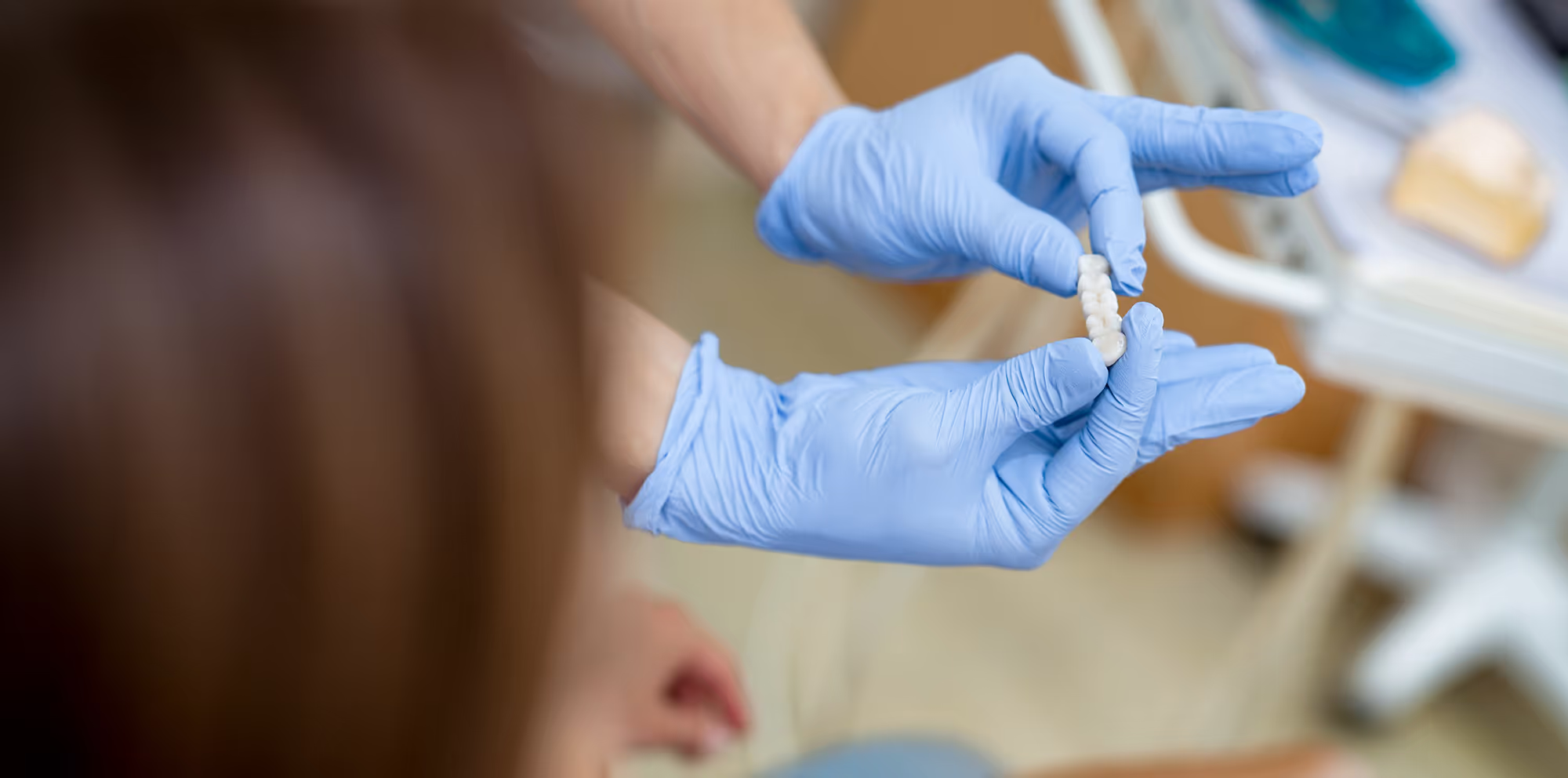
Quick answer: If your crown is loose or has fallen off, take it out of your mouth so you do not swallow it, store it in a clean container, and call your dentist the same day. Avoid chewing on that side and never use superglue. Most crowns can be recemented if the tooth underneath is healthy, but that needs to be checked.
You are halfway through dinner when you bite down and feel something hard and out of place.
You fish it out. It is your crown.
Or maybe it has not come out yet. It just wiggles when you touch it with your tongue, and now you cannot stop checking it.
Either way, the first reaction is usually the same: Is this an emergency? Did I break something? Can I just push it back on?
The simple answer is that a loose crown is usually fixable, and the first steps are easy: protect the crown, protect the tooth, and call your dentist.
The more honest answer is that the crown is often not the real problem. Crowns usually come loose because something changed underneath, and that is what your dentist needs to find.
Is a Loose Crown a Dental Emergency?
Usually it is urgent, but not a hospital emergency.
A loose or missing crown is not always painful, but the tooth underneath is now exposed. It can be sensitive, it can break more easily, and decay can progress if it is left uncovered.
If you live in La Puente, West Covina, Baldwin Park, or nearby, call our office as soon as you notice it. Our emergency dentistry team offers same-day appointments for problems like lost crowns and fillings.
Go to the ER only if you have trouble breathing, think you may have inhaled the crown, have facial swelling that is spreading, or have heavy bleeding that will not stop. Hospitals can manage those situations, but they cannot repair the crown itself.
Our guide on what to do during a dental emergency covers other urgent situations.
What Should I Do First If My Crown Came Loose?
1. Get it out of the way safely
If the crown is very loose or has already come off, remove it from your mouth so it cannot slip down your throat.
This is not a theoretical worry. In a 10-year review of incidents at a dental school, fixed crowns and bridges were the type of treatment most often involved when patients swallowed or inhaled dental objects, and swallowing was much more common than inhaling (Tiwana et al., 2004).
2. Keep the crown
Rinse it gently and place it in a small, clean container or zip bag. Bring it to your appointment. If it is intact, it may be reusable.
3. Look, but do not poke
Check the tooth in a mirror. Is it whole? Is there a sharp or broken edge? Is anything dark or soft-looking? Make a note to tell your dentist.
4. Keep the area clean
Rinse with warm water and brush gently around the exposed tooth. Food trapped against it can irritate the gums.
5. Chew on the other side
Avoid sticky, hard, or very hot and cold foods on that side until the tooth is covered again.
6. Call your dentist
Tell the office whether the crown is loose or fully off, whether you still have it, and whether you have pain or swelling.
What Should I Avoid Doing?
- Do not use superglue or household glue. It is not made for the mouth, it can irritate the gums, and it can make it harder to clean and reseat the crown properly.
- Do not force the crown back on. If it does not seat easily, it may be tilted or blocked by debris or broken tooth, which can crack the tooth further.
- Do not sleep with a very loose crown in place. That is when it is most likely to be swallowed.
- Do not wait for months. A tooth that “feels fine” can still be decaying or weakening under the surface.
Can I Put My Crown Back On Myself?
Some pharmacies sell temporary dental cement. In a pinch, a dentist may tell you it is okay to use a small amount as a stopgap until your visit.
But it is only a short-term cover. It does not seal the crown properly, it can trap bacteria, and if the crown is seated even slightly wrong, your bite will be off.
Call first, then decide. Often the safest choice is to keep the crown in a container and be seen the same or next day.
Why Did My Crown Come Loose?
Crowns are durable. Large reviews show that most modern single crowns are still in place after 5 years, with about 95% to 97% survival for metal-ceramic and many all-ceramic types (Sailer et al., 2015).
Still, loss of retention is one of the most commonly reported crown problems. A review of fixed prosthodontic complications listed loss of retention among the top three complications for single crowns (about 2%), and found decay was the most common complication under bridge supports (about 18% of abutment teeth) (Goodacre et al., 2003).
Common reasons include:
- Decay under the edge of the crown. Bacteria can work in at the margin and soften the tooth that holds the crown.
- Cement breakdown over time.
- A short or tapered tooth. Crown retention depends partly on tooth shape. Research guidelines call for a minimum tooth height and limited taper so the crown has enough grip (Goodacre et al., 2001).
- Grinding, clenching, or biting very hard or sticky foods.
- Material type. One large review found zirconia single crowns had significantly more loss of retention than metal-ceramic crowns (Sailer et al., 2015).
- A loose implant screw. If the crown is on an implant, a loose abutment screw is one of the most frequently reported technical problems (Srinivasan et al., 2017).

Can the Same Crown Be Recemented?
Often, yes, if the crown is intact and the tooth is healthy. Here is how the fix usually depends on what we find:
| What we find | Likely fix | Visits |
|---|---|---|
| Crown intact, tooth healthy | Clean and recement the original crown | Often one |
| Small decay at the edge | Remove decay, rebuild the core, then recement or remake the crown | One to two |
| Crown cracked or poorly fitting | New crown, with a temporary in between | Usually two |
| Tooth broken or deep decay | Core buildup, possible root canal, then new crown | Several |
| Tooth cannot be saved | Extraction, then an implant or bridge | Several, over months |
| Crown on an implant | Tighten or replace the abutment screw, check the implant | Often one |
If a new crown is needed, our dental crowns and porcelain crowns pages explain the process. If the nerve is involved, see our root canal page.
Is It a Loose Crown or a Broken Tooth?
It is not always obvious which one you are dealing with. A few clues can help:
- The crown comes off in one clean piece and the inside looks hollow and smooth. This often means the cement let go.
- There is tooth or filling material stuck inside the crown. Part of the tooth or core may have broken off with it.
- The crown wiggles but will not come off. It could be loose cement, decay at the edge, or, on an implant, a loose screw.
- The tooth looks dark, soft, or very short. Decay may have weakened what is left.
None of these is a diagnosis. They are just useful details to share when you call.
What Happens at Your Loose Crown Appointment?
A typical visit for a loose or lost crown looks like this:
- Exam and questions. We look at the crown and the tooth and ask how and when it came loose.
- X-rays. These show decay under the edge, the health of the root, and the bone around it.
- Cleaning and test fit. If the crown and tooth look healthy, we clean off old cement and check that the crown still seats properly.
- Recement or protect. If it fits, we recement it. If not, we protect the tooth with a temporary crown while a new one is made.
- A clear plan. We explain what we found and any next steps, with costs, before doing more.
Most patients leave the first visit with the tooth covered and comfortable.
The Biggest Difference: A Crown That Slipped Off vs. a Tooth That Failed Underneath
Two people can have the exact same experience: the crown pops off while eating.
For one, the cement simply wore out. The tooth is solid. The crown goes back on in one visit.
For the other, decay has been quietly eating away at the tooth under the crown for months. The crown came off because there was nothing left to hold it.
From the outside, they look the same. Underneath, they are completely different problems.
That is why we never just glue a crown back on without checking the tooth first.
What We Look at Before Recommending a Fix
- The crown itself. Is it cracked, worn through, or still a good fit?
- The tooth underneath. Decay, fractures, and how much healthy structure remains.
- The nerve. Lingering pain or swelling may point to a nerve problem.
- X-rays. To see decay and bone levels we cannot see by eye.
- Your bite and habits. Grinding or heavy biting forces that may have loosened it.
- The crown's age and history. Has it come loose before?
Risks of Waiting Too Long
- More decay. An uncovered tooth, or one with a gap under a loose crown, is easier for bacteria to attack.
- Fracture. Teeth prepared for crowns are smaller and weaker without their cover.
- Sensitivity or pain. Exposed dentin can react to temperature and sweets.
- Fit problems. The longer a tooth stays uncovered, the more likely nearby teeth can drift, and the original crown may no longer fit.
- Swallowing the crown. A very loose crown can come off while you eat or sleep.
How Much Does It Cost to Fix a Loose Crown?
It depends on what is going on underneath.
Recementing an intact crown on a healthy tooth is usually the simplest and least costly fix. A new crown, a core buildup, or a root canal costs more, because it involves more treatment.
Many insurance plans partially cover crown-related treatment, depending on the reason. Our office accepts all PPO plans, verifies your benefits, and files claims for you, and CareCredit is available for monthly payments. See our insurance and financing page for details.
How Can I Keep My Crown From Coming Loose Again?
- Brush along the gumline of the crown and floss daily, since decay at the edge is a common cause.
- Keep regular exams and cleanings so problems at the margin are caught early.
- Wear a night guard if you grind or clench.
- Use caution with very sticky candy and avoid chewing ice or hard objects.
If your crown came off because the tooth could not be saved, our dental implants FAQ walks through the next step.
Final Takeaways
- Remove a very loose or fallen crown so you do not swallow it, and keep it in a clean container.
- Call your dentist the same day. A loose crown is urgent, but usually not an ER visit.
- Chew on the other side, keep the area clean, and never use superglue.
- Crowns often loosen because of decay or tooth changes underneath.
- Many crowns can be recemented if the tooth is healthy, but the tooth must be checked first.
- Good hygiene, regular cleanings, and a night guard help keep crowns secure.

Crown Came Loose? Call Azusa Dental Clinic Today
Do not wait for a loose crown to become a broken tooth.
Bring your crown, and we will check the tooth underneath, explain what happened, and give you a clear plan to fix it. We speak English, Tagalog, and Spanish.
Call 626-336-4453 for a same-day emergency appointment, or request an appointment online.
Research References
- Goodacre CJ, Campagni WV, Aquilino SA. Tooth preparations for complete crowns: an art form based on scientific principles. J Prosthet Dent. 2001;85(4):363-376. https://pubmed.ncbi.nlm.nih.gov/11319534/
- Goodacre CJ, Bernal G, Rungcharassaeng K, Kan JY. Clinical complications in fixed prosthodontics. J Prosthet Dent. 2003;90(1):31-41. https://pubmed.ncbi.nlm.nih.gov/12869972/
- Sailer I, Makarov NA, Thoma DS, Zwahlen M, Pjetursson BE. All-ceramic or metal-ceramic tooth-supported fixed dental prostheses (FDPs)? A systematic review of the survival and complication rates. Part I: Single crowns (SCs). Dent Mater. 2015;31(6):603-623. https://pubmed.ncbi.nlm.nih.gov/25842099/
- Srinivasan M, Meyer S, Mombelli A, Müller F. Dental implants in the elderly population: a systematic review and meta-analysis. Clin Oral Implants Res. 2017;28(8):920-930. https://pubmed.ncbi.nlm.nih.gov/27273468/
- Tiwana KK, Morton T, Tiwana PS. Aspiration and ingestion in dental practice: a 10-year institutional review. J Am Dent Assoc. 2004;135(9):1287-1291. https://pubmed.ncbi.nlm.nih.gov/15493393/


